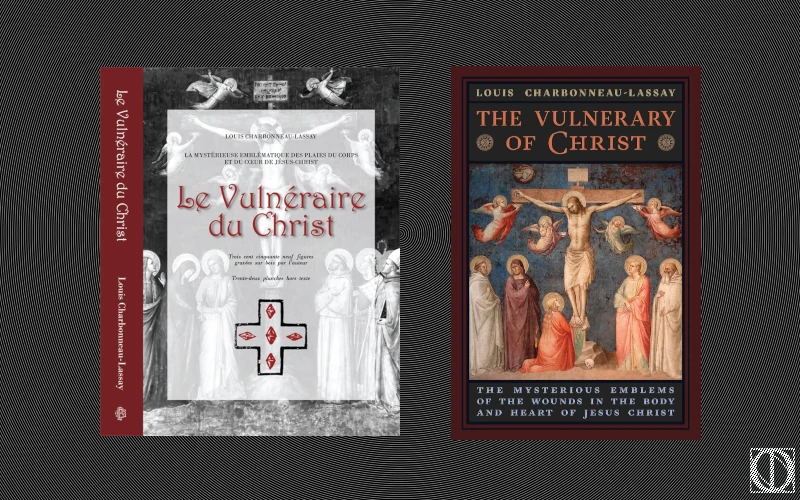
Le Vulnéraire du Christ: La mystérieuse emblématique des plaies du corps et du coeur de Jésus-Christ (The Vulnerary of Christ: The Mysterious Emblematic of the Wounds in the Body and Heart of Jesus Christ) stands as the final, posthumous work of the French symbologist Louis Charbonneau-Lassay (1871-1946). Completed in 1946, the original manuscript was tragically lost for decades. The edition known today is a meticulous reconstruction by researcher Gauthier Pierozak, based on the author’s extensive archives, and was first published in its reconstituted form in French by Gutenberg Reprint in 2018. This work completes the author’s seminal trilogy on Christian symbolism, alongside Le Bestiaire du Christ (1940) and his studies on the Sacred Heart.
The term “vulnéraire” (from the Latin vulnus, meaning “wound”) accurately defines the book’s scope: it is a comprehensive treatise on the symbolism of the Five Wounds of Christ and the Arma Christi (Instruments of the Passion). Charbonneau-Lassay’s methodology is characteristically erudite, combining historical, archaeological, and iconographic analysis with a hermeneutics of symbols rooted in the perspective of the perennial philosophy. The book is structured as an encyclopaedic study, examining the representation of Christ’s wounds in early Christian art, medieval heraldry, and various esoteric traditions. A significant portion of the work is dedicated to the symbolism of the Sacred Heart, which it presents not as a modern devotion but as an ancient expression of the “fountain of life” emanating from Christ’s side.
A notable feature of the volume is its rich iconography, which includes 359 woodcut illustrations engraved by the author himself, making it a work of artistic as well as scholarly value. The research also delves into the emblematic use of specific plants and stones associated with the Passion and discusses mystical brotherhoods dedicated to this devotion, reflecting Charbonneau-Lassay’s connections to the intellectual circles of René Guénon.
The work’s dissemination has been ensured through translations into the main Western languages. The English translation, titled The Vulnerary of Christ, was published by Angelico Press in 2020. The Spanish edition, El Vulnerario de Cristo: La misteriosa emblemática de las llagas del cuerpo y del corazón de Jesucristo, was published by Ediciones Lectio in 2021, translated by Cristian Jacobo. The availability of these translations has facilitated the international academic reception of this essential text.
In conclusion, Le Vulnéraire du Christ is an indispensable work for specialists in religious symbolism, art history, and Western esotericism. It represents the culmination of a lifetime of research dedicated to deciphering the deep structures of Christian iconography, solidifying Charbonneau-Lassay’s legacy as a paramount figure in the study of traditional symbolism. The successful reconstruction and translation of this lost manuscript have restored a fundamental piece of 20th-century scholarship to the academic community.