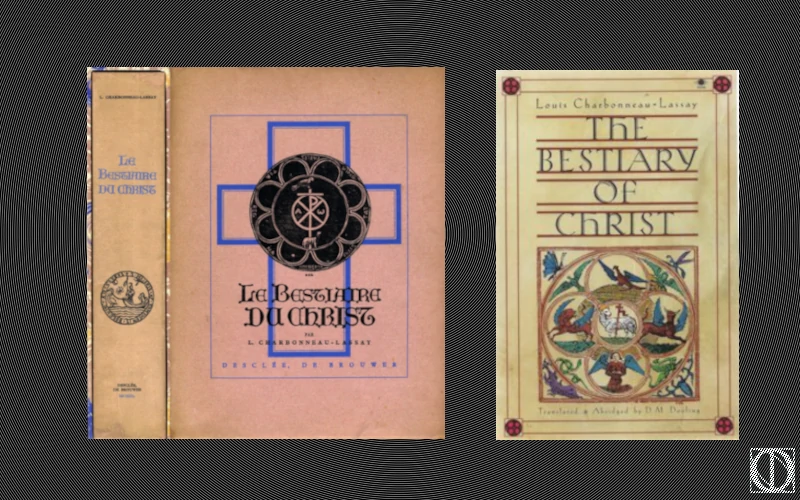
Le Bestiaire du Christ: La mystique des animaux, symbolisme et iconographie (The Bestiary of Christ: The Mystique of Animals, Symbolism and Iconography) is the magnum opus of French symbologist Louis Charbonneau-Lassay (1871-1946). Published originally in 1940 by Desclée de Brouwer in Bruges, this monumental work of nearly 1100 pages and over 1100 illustrations represents the culmination of fifty years of research into the symbolic language of the Christian tradition. It stands as one of the most comprehensive and erudite studies of its kind in the twentieth century.
The work is framed within the long tradition of medieval bestiaries but transcends them through its systematic depth and comparative scope. Whereas ancient bestiaries often blended fabulous natural history with moralization, Charbonneau-Lassay focuses exclusively on deciphering how the entire animal kingdom—comprising real and fantastic creatures such as the lion, the pelican, the phoenix, and the unicorn—was understood by the Church Fathers and medieval theologians as a symbolic book revealing the mystery of Christ. The central thesis posits that each animal embodies an aspect of Christ’s nature, his redemptive work, or his majesty.
Charbonneau-Lassay’s methodology is rigorously comparative. For each animal, he compiles and contrasts interpretations from patristic sources, biblical references, popular legends, and, crucially, iconographic manifestations found in architecture, sculpture, and illuminated manuscripts. This approach, deeply influenced by the school of traditional symbolism and his mentor Marius Schneider, seeks to demonstrate the “transcendental unity” of symbolic meanings across diverse cultures and epochs within the Christian worldview. The profusion of illustrations, many drawn by the author himself from archaeological findings, is an integral part of the text, making the volume an indispensable tool for art historians and iconographers.
The reception and influence of Le Bestiaire du Christ have been significant. After a period of relative obscurity, it was republished in French in 1974 and again in a definitive edition by Archè Milano in 2006. Its global importance was confirmed with its translation into other languages. A partial English translation was published by Parabola Books in 1991, but a landmark was reached in 2021 when Inner Traditions published the first complete and unabridged English translation, entitled The Bestiary of Christ, making the entire work accessible to an international academic audience. For Spanish readers, the foundational translation was made available by Alpha Editrice, often distributed in collaboration with Ediciones Lectio, under the title El Bestiario de Cristo.
In conclusion, Le Bestiaire du Christ is an encyclopedia of symbolic thought and a testament to a lifetime of scholarly dedication. It remains an essential reference for any serious study of Christian iconography, comparative religion, and the history of symbols, securing Charbonneau-Lassay’s position as a pivotal figure who bridged erudite archaeology with a profound understanding of traditional metaphysics.