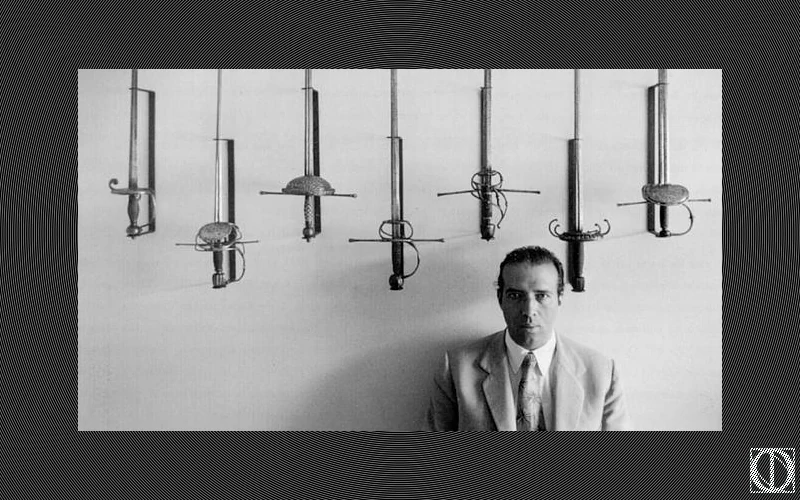
Juan Eduardo Cirlot Laporta (1916-1973) was a Spanish poet, art critic, musicologist, and theorist of symbolism whose intellectual trajectory represents a unique case in 20th-century Hispanic culture. His life was marked by an unceasing quest for a total system of knowledge through the symbol. Initially influenced by Surrealism and Dada aesthetics during his youth in Barcelona, a decisive turning point came in 1949 with his meeting of the musicologist and anthropologist Marius Schneider at the Argos bookshop in Barcelona. Schneider introduced him to traditional symbology and perennial philosophy, steering his work towards a systematic and comparative study of universal symbols.
Cirlot developed a vast and erudite body of work that encompassed poetry, art criticism, and, most significantly, his symbolological studies. His early engagement with the avant-garde informed his lifelong interest in the transformative power of the image. As an art critic, he was an early and vocal defender of abstract and experimental art in Francoist Spain, recognising its deep symbolic content. His theoretical thought, which also drew upon the philosophy of Hegel, occultism, and incipient structuralism, made him a unique bridge between the Hermetic tradition and the artistic avant-gardes of his time.
Cirlot’s poetic output is monumental, particularly the Bronwyn cycle (1967-1971), an ambitious work where he projected his entire personal symbolic universe into literary form. However, his influence extends through his critical and theoretical writings. Key works include:
- El mundo del objeto a la luz del surrealismo (The World of the Object in the Light of Surrealism, 1953): An early essay analysing the symbolic transformation of objects in Surrealist art.
- Introducción a la mitología (Introduction to Mythology, 1955): A study of myths as expressions of universal symbolic structures.
- La pintura de Antoni Tàpies (The Painting of Antoni Tàpies, 1961): A prime example of his art criticism, applying his symbolic method to a contemporary artist.
Cirlot’s methodology was fundamentally comparative and synthetic. He believed in the “transcendental unity of all traditions,” seeking parallels between diverse cultural expressions—from Norse mythology to Kabbalah, from alchemy to modern poetry. This approach, heavily influenced by the Jungian concept of the collective unconscious and the traditionalist school of thought (e.g., René Guénon), aimed to uncover a fundamental, archaic language of images underlying human consciousness. Though sometimes criticised by academic specialists for its universalist tendencies, this very perspective is what gives his work its unique power and enduring appeal for artists, writers, and seekers of meaning. Juan Eduardo Cirlot remains a seminal figure for understanding the deep connections between symbol, psyche, and modern art.