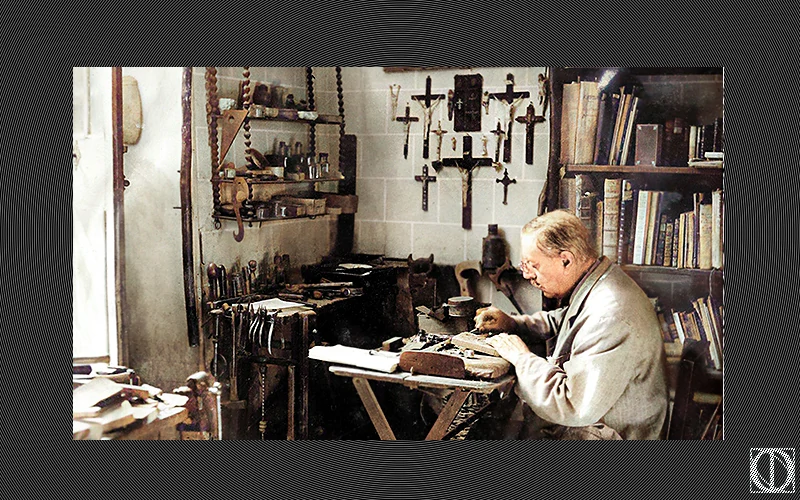
Louis Charbonneau-Lassay (1871-1946) was a French scholar whose work constitutes an essential chapter in the revitalisation of the study of Christian symbolism during the first half of the 20th century. Although by profession an engraver in his native town of Loudun, his true vocation was that of a meticulous archaeologist and historian, dedicated to deciphering the lost language of Christian iconography and emblemata. His work, rigorous and vast, is characterised by a profound personal faith and a method that combined historical research with an internal understanding of symbols as vehicles for spiritual realities. This approach places him in a unique position, straddling academic erudition and Christian esotericism.
Archaeologist of the Symbol and Relationship with René Guénon
Charbonneau-Lassay’s importance lies in his triple role. As an engraver, he possessed a practical knowledge of forms and lines that gave him a special sensitivity for analysing ancient images. As an archaeologist and historian, he spent decades studying in situ and cataloguing thousands of engraved stones, amulets, seals, and medieval emblems, particularly from the Poitou region. But it was as a symbolist that he reached his greatest height. His approach was not merely descriptive; he sought to penetrate the deep theological and spiritual meaning of symbols, understanding them as expressions of a sacred science.
This perspective brought him intellectually close to René Guénon, with whom he collaborated on the journal Regnabit. Revue Universelle du Sacré-Coeur during the 1920s. Charbonneau-Lassay was one of the few collaborators whom Guénon, always critical of modern studies on esotericism, deeply respected. He saw in him an authentic representative of a Christian traditional intellectuality, capable of expounding the esoteric doctrine inherent in Christianity with rigour and orthodoxy. However, unlike Guénon, who considered the Christian esoteric path practically extinct in the West, Charbonneau-Lassay believed in its hidden continuity and the possibility of its renewal from within Catholic orthodoxy. This difference did not prevent a fruitful collaboration based on mutual respect.
Principal Works
His magnum opus is The Bestiary of Christ: The Symbolism of Animals in Antiquity and the Middle Ages (1940). This encyclopaedia of almost 1100 pages is a monumental study of the symbolism of animals (both real and fantastic) in the Christian tradition. Far from being a simple catalogue, the work shows how the entire animal kingdom was contemplated as a book of symbols revealing aspects of the mystery of Christ, the Church, and the spiritual life.
Previously, he had published a collection of his articles from Regnabit under the title The Heart of the Saviour and Cardiac Symbolism (1931). In this work, he traces the history and spiritual significance of the Heart of Jesus, showing its roots in the Church Fathers and medieval mysticism, and defending its character as a central symbol of Christianity, equivalent to the heart chakra in Eastern traditions.
His other major work, published posthumously, is Le Vultaire du Christ: Archéologie d’un Culte (1971), as no established English title exists. In it, he studies the history and symbolism of the Instruments of the Passion (the Cross, the Lance, the Sponge, etc.), demonstrating their profound significance as the “weapons” of redemption.
Charbonneau-Lassay’s labour represents a unique effort to rescue the symbolic heritage of Christianity, offering a key to reading that reconciles faith with the intelligence of symbols, and constituting a fundamental bridge between historical erudition and traditional metaphysics.