Optical illusions, understood as systematic discrepancies between physical reality and human perception, have evolved from mere psychological curiosities to constitute a fundamental field of study for understanding the cognitive mechanisms that govern our interpretation of the world. Far from being errors of vision, they are manifestations of the shortcuts and heuristic strategies the brain uses to process sensory information efficiently. This principle, once deciphered, has become an immensely powerful tool in the disciplines of design and art, enabling the creation of visual experiences that challenge, deceive, and expand the boundaries of perception.
From a neuroscientific perspective, optical illusions operate because the brain is not a passive receiver but an active interpreter that constructs reality based on expectations, prior experiences, and Gestalt grouping principles. Illusions such as the Müller-Lyer (where lines of equal length appear different due to their arrow-like endings) or the Ponzo illusion (where the convergence of lines in a perspective context alters the perception of size) demonstrate that our visual system prioritizes contextual coherence over absolute measurement. The brain assumes a three-dimensional world and adjusts perception accordingly, even when the image is flat.
In the field of design, knowledge of these principles is essential for effective visual communication. Graphic design uses Gestalt laws, such as proximity, similarity, or closure, to guide the viewer’s gaze and organize information intuitively. An effective logo, like the hidden arrow in the FedEx logotype, leverages closure to create a secondary meaning that the viewer “discovers.” In interface design (UI), understanding how we perceive contrast, colour, and movement is crucial for creating fluid user experiences (UX) and clear hierarchies. Illusions of apparent motion, for instance, are used in animated icons to indicate activity without the need for complex animations.
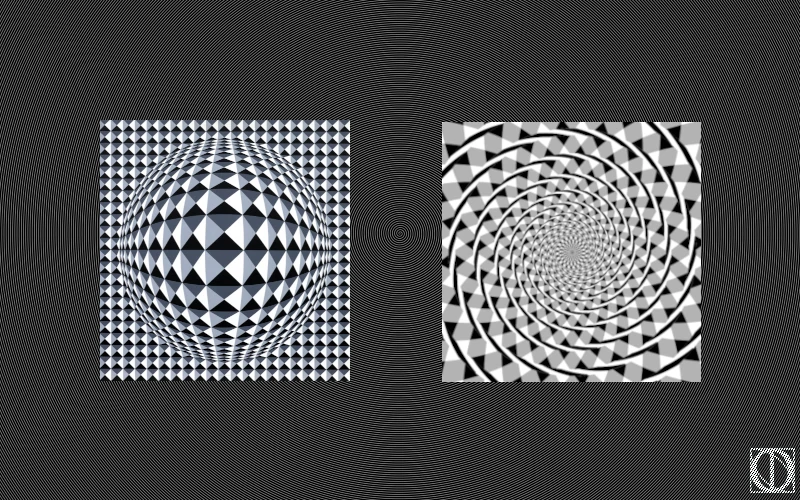
In the visual arts, the exploration of optical illusions has been both technical and conceptual. The Op Art (Optical Art) of the 1960s, with figures like Victor Vasarely and Bridget Riley, made illusion its central theme, creating abstract compositions that vibrate, pulsate, and generate a sense of unstable movement on the viewer’s retina. These works do not represent anything external; instead, they act directly on the perceptual apparatus, highlighting its plasticity and vulnerability. However, the use of illusion transcends this movement. From the Baroque trompe-l’oeil, which sought to blur architectural boundaries, to the anamorphic art of the Renaissance, which required a specific viewpoint to reveal a hidden image, artists have used these resources to question the reliability of sight and, by extension, of knowledge itself.
In conclusion, the study and application of optical illusions reveal that perception is an act of construction, not reception. By understanding and manipulating these principles, both the designer and the artist cease to be mere creators of forms and become engineers of visual experience. Their work not only communicates a message or a beauty but also illuminates the fascinating processes by which our consciousness makes sense of the world.