The golden ratio, approximately 1.6180339887…, and often denoted by the Greek letter Phi (Φ), is one of the most fascinating and meaningful mathematical constants in history. Its journey, from ancient civilizations to contemporary culture, reveals a persistent search for harmony and perfect proportion in the universe, art, and architecture.
Although its presence can be traced in the proportions of monuments like the Great Pyramid of Giza, the first rigorous mathematical definition comes from the Greek geometer Euclid (c. 325-265 BC). In his Elements, he defines it not as a number, but as a ratio: “A straight line is said to have been cut in extreme and mean ratio when, as the whole line is to the greater segment, so is the greater to the lesser.” This asymmetric yet balanced division has a unique property: self-replication, meaning the proportion is maintained infinitely.
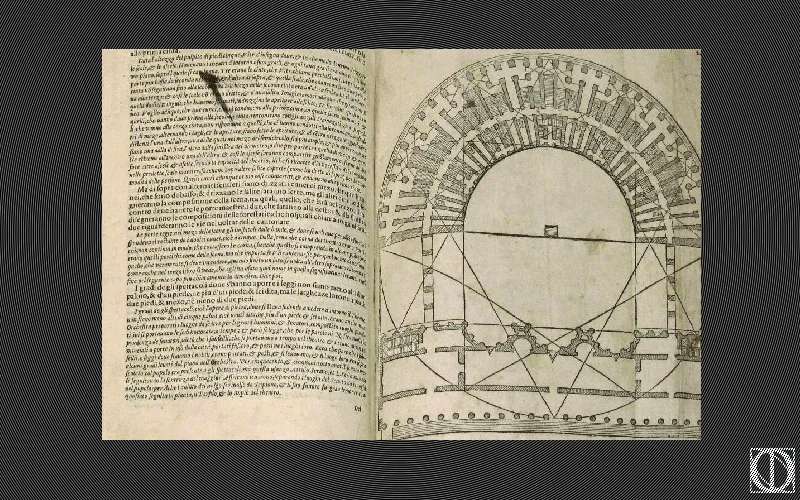
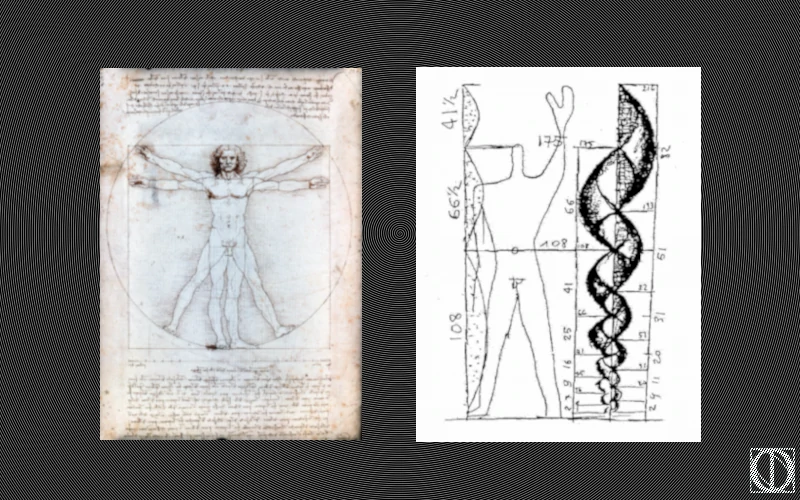
However, it was during the Renaissance that the golden ratio acquired its mystical aura and its most famous name. The Franciscan mathematician Luca Pacioli (1445-1517) published the treatise De Divina Proportione (On the Divine Proportion) in 1509. In this work, Pacioli did not discover the ratio, but he exalted its unique qualities, attributing to it divine characteristics such as uniqueness and trinity (as it involves three segments). The immense influence of this book lay in its illustrations: the magnificent drawings of geometric solids were made by his friend and collaborator, Leonardo da Vinci. Da Vinci consciously applied this proportion in his masterpieces to achieve an inherently pleasing compositional balance. The face and body structure of the Mona Lisa, as well as the arrangement of elements in the Vitruvian Man—where the perfect human body is inscribed within both a square and a circle—are paradigmatic examples of the use of the golden section.
One of the most famous geometric derivations of Phi is the golden spiral. This logarithmic spiral is built from a series of golden rectangles, whose ratio between the longer and shorter side is Phi. By connecting opposite vertices of successive squares inscribed within these rectangles with an arc of a circumference, a spiral is generated that expands infinitely without changing its shape. This spiral has been found in growth patterns in nature, such as in the nautilus shell, sunflowers, or the arrangement of galaxies, reinforcing its association with an organic and universal beauty.
In architecture, its application has been theorized in countless buildings. From the Parthenon in Athens, where the dimensions of the facade appear to fit golden rectangles, to the front of Notre-Dame Cathedral in Paris or the modern works of Le Corbusier, who integrated it into his proportional system Le Modulor.
Today, the golden ratio transcends pure mathematics to become a cultural symbol of beauty, a bridge between reason and aesthetics, and a reminder that order and harmony underlie both human creation and nature.
This is te history of Phi, the golden ratio.